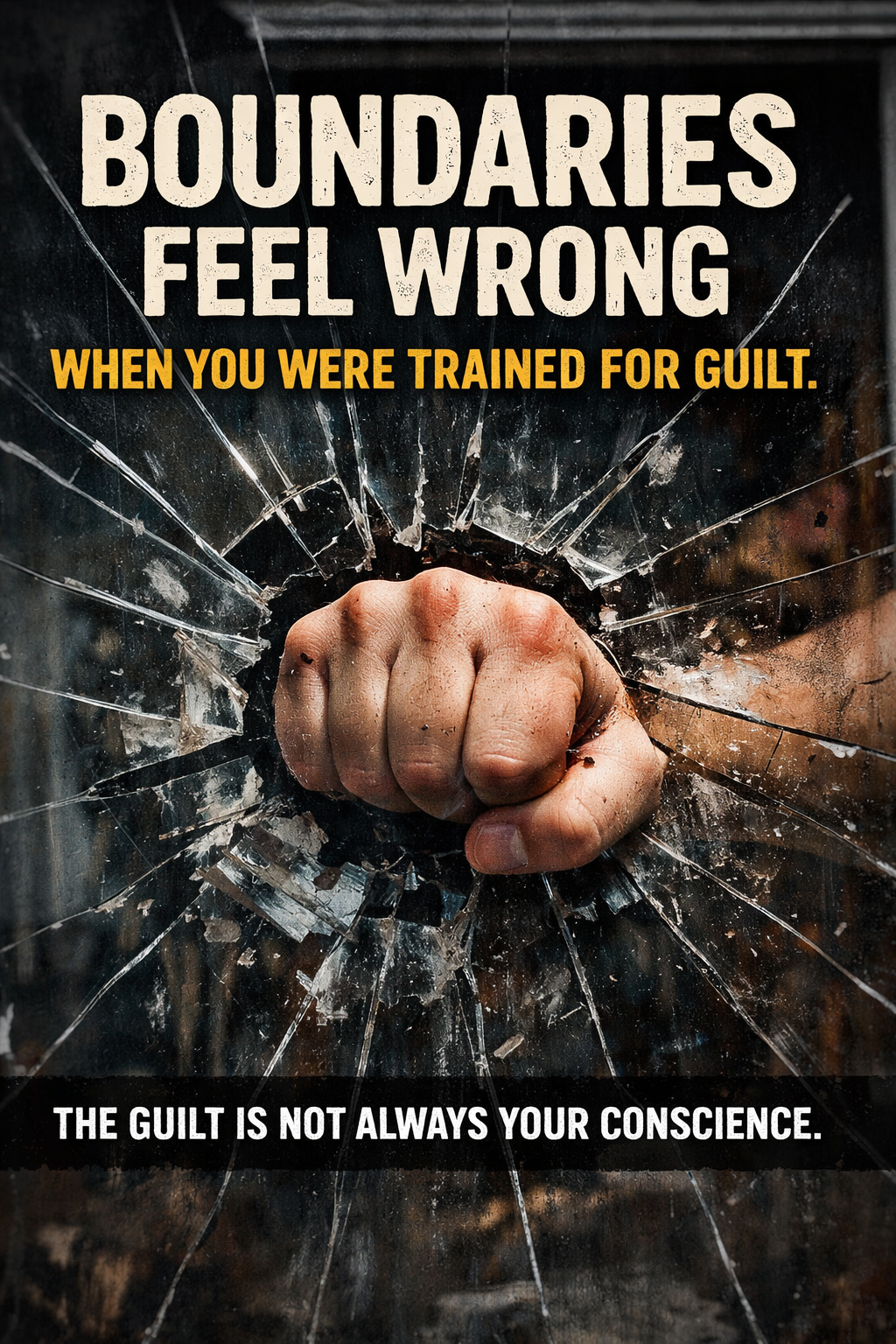
Boundaries Feel Wrong When You Were Trained for Guilt
A lot of people think guilt after a boundary means the boundary was wrong.
I don’t think that’s true.
A lot of the time, the guilt shows up because the boundary touched an old training:
keep the peace,
stay available,
don’t upset anyone,
don’t be the difficult one,
don’t make your needs more important than someone else’s comfort.
That’s where it gets real for me.
Because I’ve seen how a boundary can be clear, necessary, and still get treated like the offense.
You say you need space.
You say this is what works for me.
You say I’m not available for this dynamic anymore.
And instead of being respected, the boundary gets stepped over.
Minimized.
Rewritten.
Violated.
Then, if you react to the violation, the whole thing gets turned around on you.
Now you’re too harsh.
Too sensitive.
Too rigid.
Too much.
That’s the move.
And if you grew up in family dynamics where reality was often rearranged to protect someone else’s comfort, then boundary guilt hits hard because it’s not just about the present moment.
It hits the old wiring.
For me, that’s been part of the mother wound.
Not just that a boundary had to be set.
But that once it was set, it still wasn’t safe.
Because the problem wasn’t only the original behavior.
It was the gaslighting after.
The denial.
The stepping around the actual issue.
The subtle rewriting of what was said.
The pressure to make my boundary sound unnecessary, unkind, or unfair.
The attempt to turn my act of self-protection into something I was supposed to feel bad for.
That’s what a lot of people are up against. Maybe this is you?
Not simple disagreement.
A system that trained them to doubt their own limits.
Read: The Architecture of control
That’s why boundary guilt shows up so fast.
Not because the boundary is wrong.
Because some part of you still remembers: when I protect myself, I get turned into the problem.
That’s a real body memory.
So when people talk about boundaries like it’s just a matter of saying no more confidently, I don’t buy it.
Sometimes the issue isn’t confidence.
Sometimes the issue is that your nervous system has learned that a boundary will be met with:
pushback,
distortion,
violation,
withdrawal,
or a full rewrite of reality.
That changes things.
Because then the boundary guilt isn’t just “I feel bad.”
It’s:
I know what happens when I stop cooperating.
I know what happens when I don’t play the role.
I know what happens when I choose truth over access.
That’s why boundaries can feel guilty before they feel clean.
You’re not just setting a limit.
You’re breaking an old survival agreement.
The agreement that says:
stay reachable,
stay useful,
stay easy,
stay available,
stay in the role, don’t make anyone else deal with your no.
That’s why the guilt hook can flare even when the boundary is exactly right.
And in my experience, the guilt gets worse when the other person refuses reality.
Because now you’re carrying two things: the original reason for the boundary and the emotional pressure of being told, directly or indirectly, that your boundary is the real problem.
That’s exhausting.
And it’s why some people fold.
Not because they don’t know the truth.
Because they get tired of holding it alone.
I know that territory.
The boundary is clear.
The violation happens anyway.
Then the old conditioning, the architecture of control kicks up:
maybe I’m overreacting,
maybe I should soften it,
maybe I should explain it better,
maybe I’m the one making this hard.
That’s the trap.
Because once the gaslighting gets inside, you stop relating to the boundary as truth and start relating to it as something you have to defend in court.
That’s no longer a boundary.
That’s self-abandonment circling back in through the mind.
What I’m learning is that guilt after a boundary is not always conscience.
Sometimes it is old conditioning losing leverage.
Sometimes it is the body remembering what it cost to say no in the family system you came from.
Sometimes it is the aftershock of choosing yourself in a place where self-protection was treated like betrayal.
That matters.
Because if you don’t understand that, you’ll keep taking the guilt as evidence that the boundary was wrong.
When a lot of the time, the guilt is simply proof that the old system doesn’t like losing access to you.
That doesn’t make boundaries easy.
But it does make them clearer.
It helps me ask a better question.
Not: why do I feel guilty?
But: whose comfort did this boundary stop protecting?
That usually tells the truth faster.
Boundaries feel wrong when you were trained for guilt.
Especially when the people around you are invested in making your limits look like the problem.
But wrong is not the same as unfamiliar.
And guilt is not the same as guidance.
Sometimes the boundary is right,
and the guilt is just the noise made by an old system losing control.
Share this with someone who set a necessary boundary and got treated like the problem for no longer cooperating with the lie.
