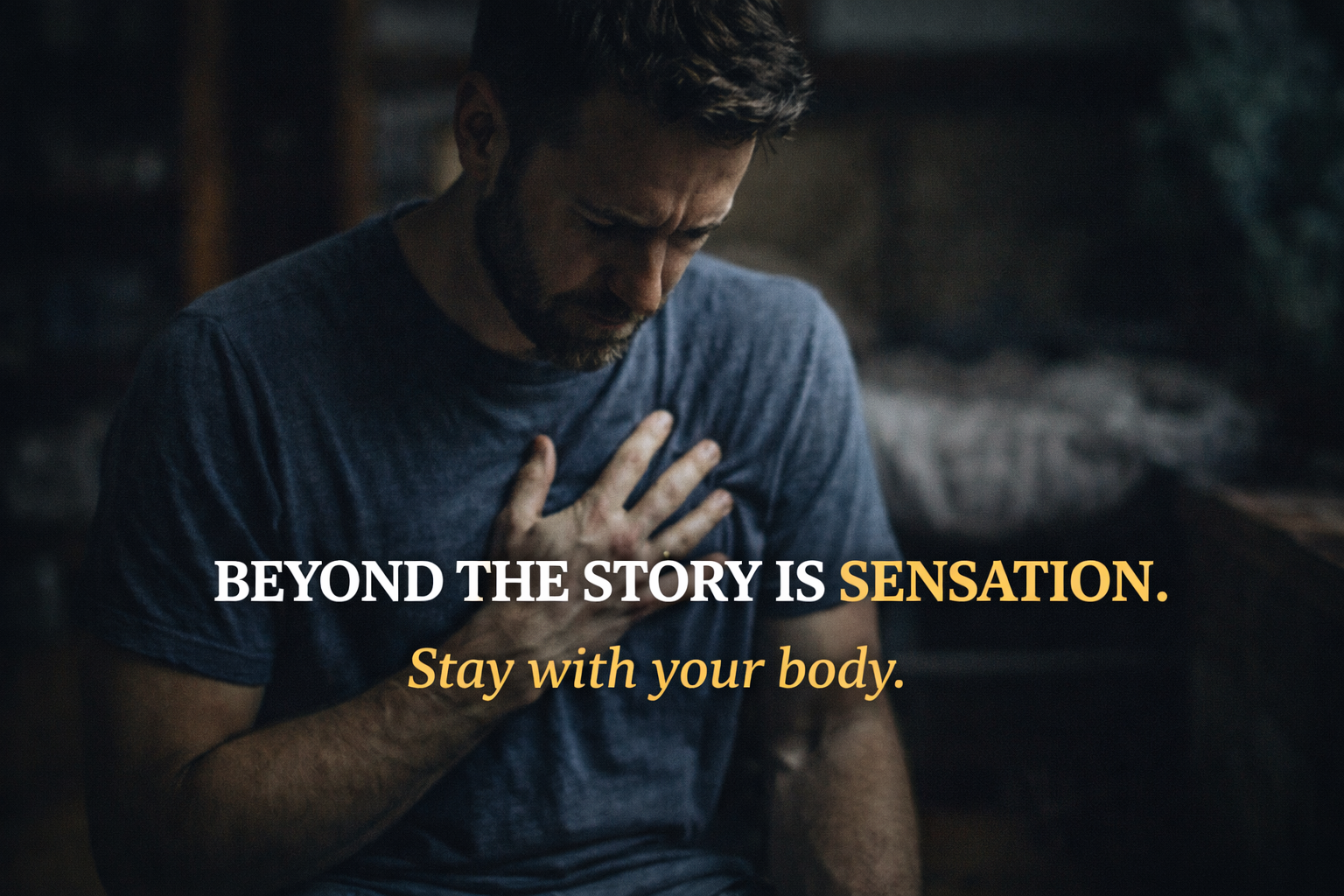
Beyond the Story Is Sensation
I’ve spent plenty of time in the story.
The story matters. It gives shape to things.
Context.
Sequence.
Meaning.
Why I’m like this.
What happened.
What it cost.
Who was there.
Who wasn’t.
How the whole stack got built.
That matters.
But I’m also seeing something else. I can know the story and still feel the same clamp in my jaw.
The same fog. The same heaviness in my chest.
The same urge to leave myself when something real gets close.
That’s the piece people miss.
Knowing is not the same as moving it.
There’s a point where insight stops being enough.
Where the story has done what it can do.
And what’s left is sensation.
The body carries what the mind already understands.
The tightening.
The dread.
The pressure.
The collapse.
The agitation.
The numbness.
The feeling showing up with no image, no clean narrative, no tidy explanation.
Just there.
And if I’m honest, that’s the part I’ve wanted to get around more than through.
Because the story can feel safer. Story gives distance.
You can explain.
Track.
Organize.
Make sense of it.
Sensation is different.
Sensation doesn’t care how well you explain yourself.
It just shows up in the body and asks: can you stay here now?
That’s where it gets real.
Because a lot of trauma is not just living in what happened.
It’s living in what the body still does.
How it braces.
How it shuts down.
How it fogs out.
How it says not now.
How it moves to function before truth gets a chance to land.
I know that move.
I’ve lived a lot of my life trying to understand what hurt while also not fully wanting to feel what it was doing in my body.
That’s not stupidity.
That’s protection.
If sensation was never safe growing up, why would the body suddenly treat it like home now?
That’s why this work is hard.
Not because the ideas are hard.
Because staying in the body when the body starts telling the truth is hard.
And I don’t think most people can do that alone.
I don’t.
Not the real stuff.
Not the deep discomfort.
Not the edge where the system wants to eject.
Not the place where the Strong One starts carrying harder, the Protector stays on duty, and some other part tries to fog the whole thing out before it opens.
That’s where you need someone steady.
Not someone with the right lines.
Not someone who looks caring.
Someone who can actually sit there with you
without rushing,
without fixing,
without flinching,
without helping you escape your own experience too fast.
That kind of presence matters.
Because healing is not just having better language for why you hurt.
It’s when the body starts changing.
Maybe slowly.
Maybe unevenly.
Maybe after a stretch where things feel worse because what was frozen is finally thawing.
But something starts shifting.
The jaw doesn’t clamp as hard.
You stay present a little longer.
You don’t disappear from yourself as fast.
The grief comes closer.
The shutdown gets noticed earlier.
The system doesn’t have to go as offline to survive the moment.
That’s real.
Not dramatic.
Not performative.
But real.
I think that’s part of why I’m losing patience with healing that lives mostly in the head.
If nothing in the body is changing, if nothing in your actual way of being is changing,
if you can explain yourself beautifully and still abandon yourself on cue, then something deeper is still waiting.
That’s not failure.
It just means story has taken you to its limit.
Beyond the story is sensation.
And somewhere beyond that, if the room is steady enough and you don’t leave,
something old finally starts to move.
That’s the work.
Not sounding aware.
Staying long enough for the body to tell the truth it’s been holding.
Share this with someone who understands their story but knows their body is still carrying more than words can reach.
