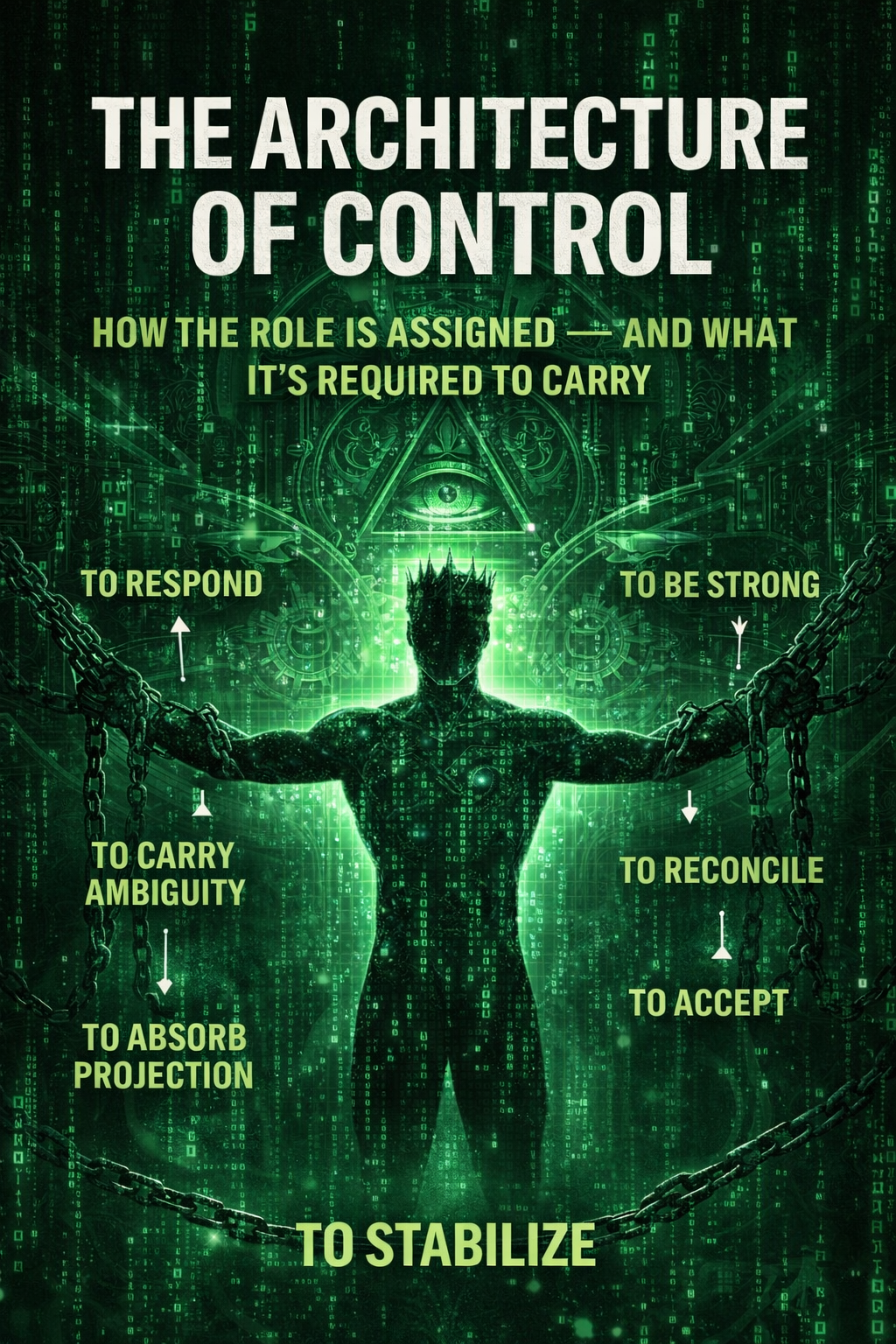
The Architecture of Control
Every control system runs on roles.
Not relationships.
Roles.
Once you’re assigned one, your needs are no longer primary. Your function is.
How the Role Gets Installed
Step 1 You Become the Regulator
If there is chaos in the system, you become the stabilizer. If there is guilt, you are the carrier. If there is grief, you are the processor. You are not a son or a daughter. You are a pressure valve.
Step 2 Your Needs Are Reframed as Malfunction
The system cannot compute autonomy. “this nonsense has to end”
• If you ask for space, you’re "avoiding."
• If you set boundaries, you’re "confused." “get yourself togethor”
• If you disagree, you’re "rejecting the truth."
The role requires total availability; it does not permit a self.
Step 3 You Must Accept Assigned Meaning
The system defines what happened, why it happened, and who is responsible. You are invited to participate, but never to reinterpret. If your internal experience diverges from the "official" narrative, the system corrects you.
Step 4 Love Is Conditional on Compliance
It won’t sound conditional. It will sound like: “I just want to help.” “I say this because I love you.” “We miss you.” But beneath the sentiment is a command: Return to the role. Reassume the function. Stabilize the system.
What the Role Requires
The role has needs. You do not.
The role needs to be strong, reasonable, and reconciling. It must absorb projection and carry the weight of other people's ambiguity. The role must never need protection, mirroring, or repair. Because if the role needs something, the architecture destabilizes.
How the System Activates When You Leave
When a coercive system senses a boundary holding, it doesn’t go quiet. It escalates.
It doesn't usually escalate with aggression; it escalates with "love." The message arrives wrapped in concern, family loyalty, or faith. It sounds like someone who cares deeply. It functions like a precision instrument.
Here are the moves:
• Reframe the boundary as the problem. “boundaries aren’t what you need” The issue isn't what happened before the boundary; the problem is that you drew one. You are forced to defend the boundary instead of simply holding it.
• Redirect the grief. A third party is introduced. Someone else’s suffering becomes the real issue. Your primary relationship is triangulated, keeping you in a state of high activation.
• Theological bypass. "God has sorted it." Grief is reframed as a failure of faith. If you were spiritually mature, you’d have moved on by now.
• Patronizing validation. “You did what you believed was right.” This uses the past tense to imply your current choices are understandable mistakes rather than deliberate acts of integrity.
• The guilt hook. An image of the "waiting mother" or the "suffering patriarch." Someone is hurting because of your boundary. The caretaker conditioning is designed to fire immediately: Fix it. “everyday i wait by my ipad for a message from you”
• The love close. “Everything I say is because I love you.” This makes the boundary feel like a rejection of love itself.
What the System Cannot Do
Notice what is absent from every one of those moves: Acknowledgment. There is no curiosity about your experience. No repair offered. No accountability. No recognition of you as a person with an independent interior life. There is only the demand to return.
That’s not love failing to communicate. That’s a system that was never architected for repair. Repair requires seeing the other person as separate from their function.
And you were never a person in that system. You were a role.
The Shadow Doesn’t Know It’s the Shadow
The people running these moves aren’t villains. They aren’t consciously deploying "tactics." They genuinely believe they are helping. They genuinely believe this is love.
That is why these systems are so hard to leave. The control doesn’t announce itself with a snarl; it arrives with red hearts at the bottom of a text message.
The Fulcrum
The moment everything shifts is the moment you realize: I am not the role.
When you stop running the role, the machine still runs. It just doesn’t run through you anymore. To the system, this feels like betrayal. To you, it is finally individuation.
The Clean Response
You don’t have to explain yourself. You don’t have to defend the boundary. You don’t even have to respond.
Name the moves. See the architecture. Regulate your nervous system. Then go back to your life.
You are not a function. You are not a stabilizer. You are a person. And a person has needs.
