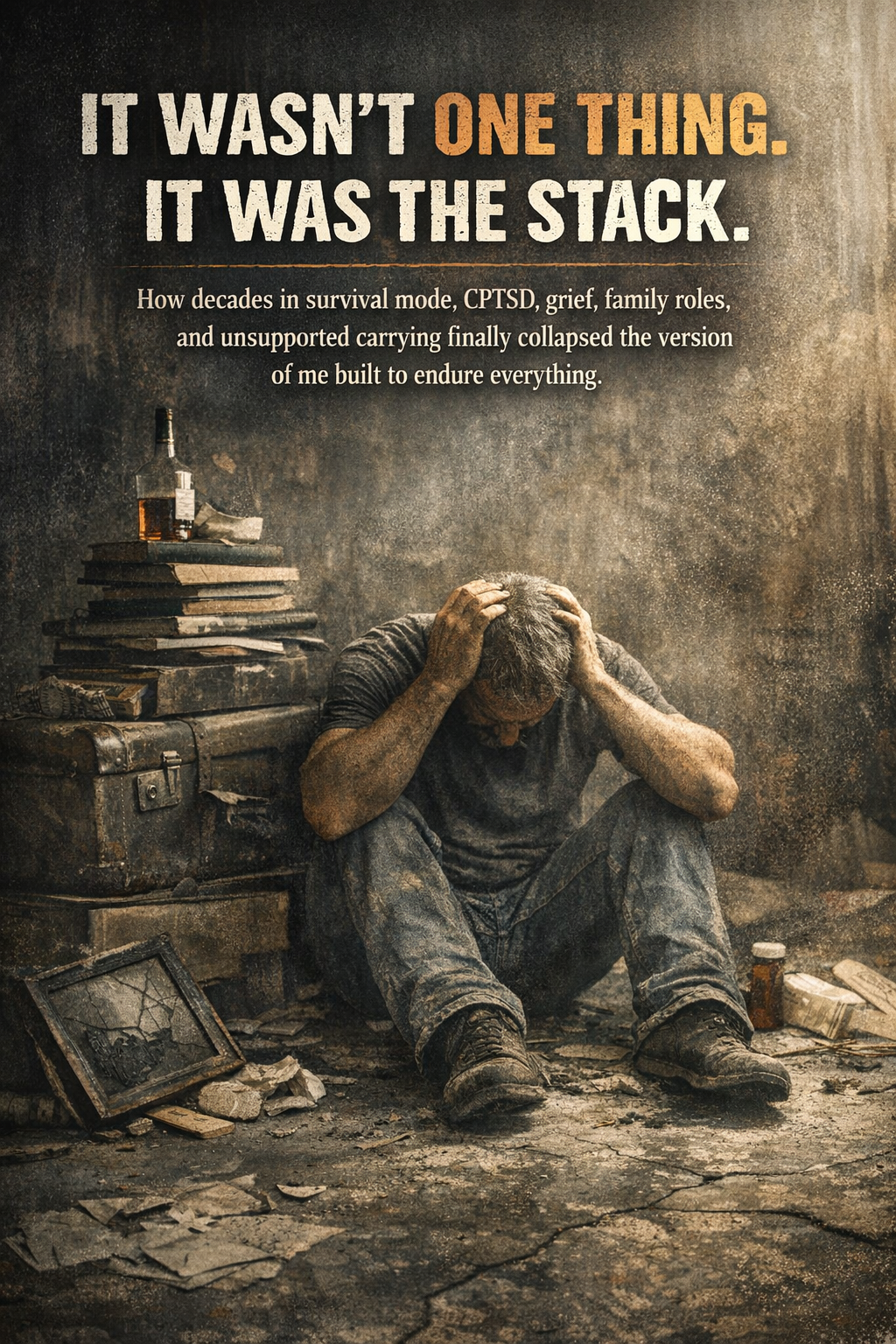
I did not collapse because of one bad event.
I collapsed under the accumulated weight of a life built in survival mode.
It was not one thing.
It was the stack.
Decades of CPTSD.
Carrying everything for everyone. Being the strong one.
No real support coming back my way.
Aidan’s addiction.
Then Aidan’s suicide.
Then Gill’s cancer.
Then the toxic family dynamics.
The roles.
The pressure.
The old system still trying to recruit me back into performance.
By the end of it, I did not really know who I was underneath all that.
I knew how to function.
I knew how to carry.
I knew how to stay useful.
I knew how to perform okay-ness.
I knew how to override my own needs so thoroughly that I stopped being truthful to myself about them.
That is what survival mode can do.
It can keep you moving long after you have gone missing inside your own life.
A lot of people talk about rock bottom like it is one dramatic moment.
One mistake.
One bad year.
One blow you never saw coming.
That was not my experience.
My experience was years of adaptation.
Years of over-functioning.
Years of being the one who carried more than he should have and asked for less than he needed.
Years of staying useful because useful gets rewarded, even when useful does not get held. Being useful instead of known
The survival strategies worked.
Until they didn’t.
That is the part I think a lot of men miss.
The same strategies that kept me upright also kept me disconnected.
They kept me moving, but they did not keep me whole.
They kept me functional, but they did not keep me honest.
They helped me survive situations that were too much for too long.
Until the bill came due.
And when it came due, it was not subtle.
I checked out.
I shut down for self-preservation.
Not because I did not care.
Because I had cared for too long without enough support, truth, grief, or room to be an actual human being in the middle of it.
That is what overload can look like.
Not drama.
Not some cinematic breakdown people know how to respond to.
Sometimes it looks like going offline.
Numbing out.
Pulling back.
Not being able to access yourself the way you used to.
Not because nothing matters.
Because too much has mattered for too long and the system has finally run out of ways to carry it.
Read what men carry the series
That was closer to the truth for me.
It was the weight of decades in survival mode.
It was the aftermath of Aidan’s addiction and then Aidan’s suicide.
It was Gill’s cancer added to an already overloaded nervous system.
It was family toxicity layered on top of grief.
It was the old roles still pressing in.
It was the false self built around carrying, helping, containing, and enduring.
And underneath all of it was a harder truth:
I did not really know who I was outside those roles.
I knew how to be needed.
I knew how to be useful.
I knew how to hold.
I knew how to absorb.
I knew how to override what I felt and call it strength.
But I did not know myself well enough.
Not underneath all the performance.
Not underneath the duty.
Not underneath the role of the one who keeps going.
That is part of what collapsed too.
Not just my capacity.
My identity.
Or more accurately, the version of me that had been built to survive by carrying everything and needing nothing.
That version could not hold anymore.
And as brutal as that was, it was also honest.
Because sometimes what breaks down is not your life.
Sometimes what breaks down is the version of you that was built to endure what should never have been carried that long in the first place.
That is not failure.
That is the nervous system finally telling the truth.
The truth was this: The life I was living was unsustainable.
The way I was living it was untruthful to my own needs.
And the survival strategies that had once protected me had outlived their usefulness.
That is a painful truth to meet.
Especially when you have spent years believing that being the one who carries it is who you are.
But it was still the truth.
And in the end, I did something that mattered.
I sought help.
That did not erase the stack.
It did not undo the grief.
It did not magically restore the parts of me that had gone offline.
But it was the first honest move after a lifetime of trying to survive by becoming what everyone else needed.
That is where rebuilding started.
Not with becoming stronger.
With finally admitting that I could not keep living like that.
With finally admitting that support was not weakness.
That collapse was not moral failure.
That grief needed room.
That CPTSD was shaping more than I wanted to admit.
That family roles had distorted my relationship to truth, need, and selfhood.
That performing okay-ness was killing something real in me.
That was the beginning.
Not of a perfect life.
Of an honest one.
And I think that matters because a lot of men are still walking around inside the stack.
Still functioning.
Still useful.
Still carrying.
Still telling themselves they are fine because the machine is technically still running.
But functioning is not the same as being okay.
And survival mode is not the same as life.
Sometimes collapse is not failure.
Sometimes it is the first honest thing the system has done in years.
If this lands, share it with the man who has been carrying the stack for so long he no longer knows the difference between functioning and living.
