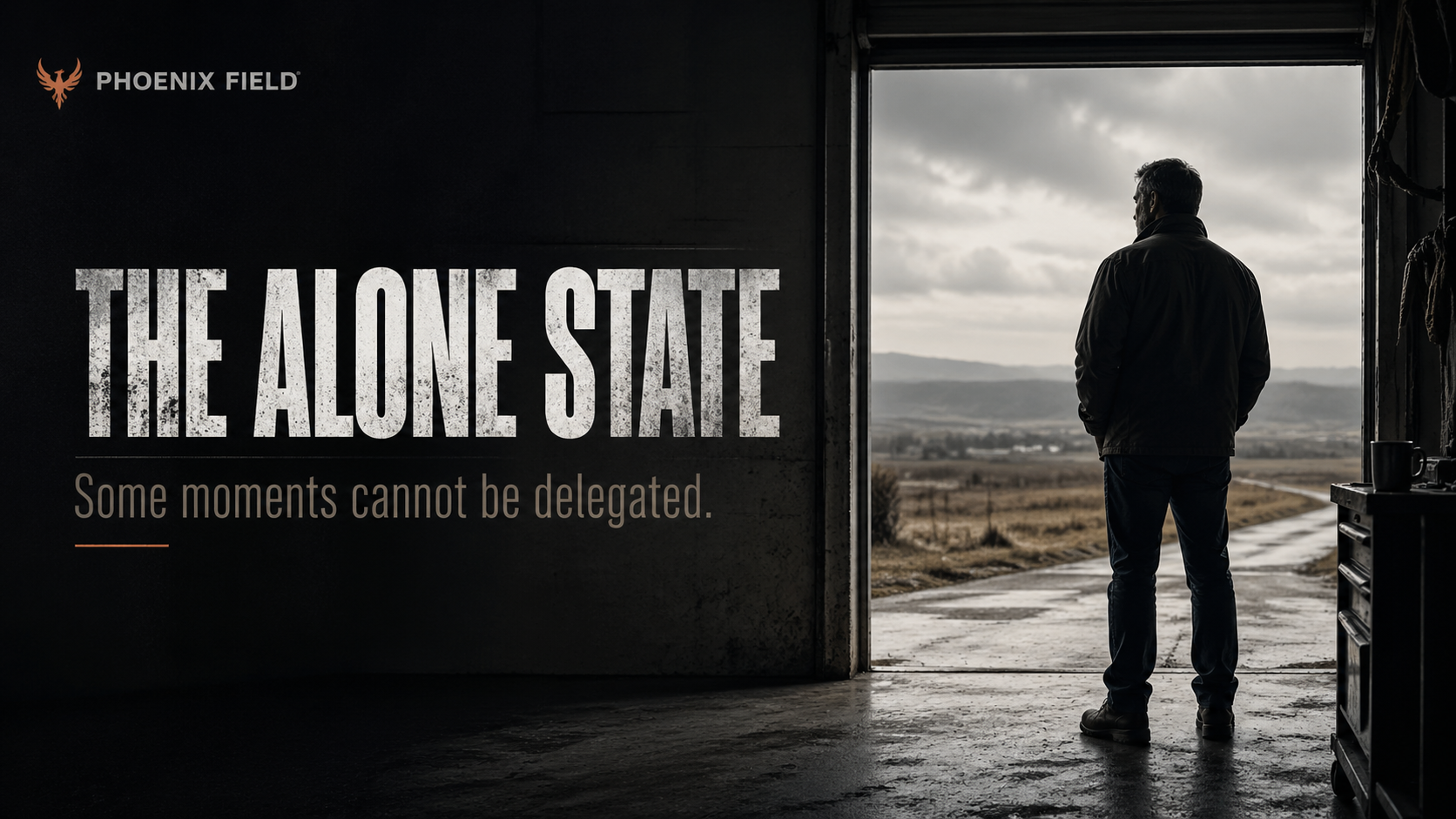
The Alone State
There is a kind of aloneness that has nothing to do with whether people love you.
That’s the first thing.
It’s not just loneliness.
Not just lack of company.
Not just wishing someone would call, show up, sit beside you, understand.
It’s deeper than that.
It’s the aloneness of being the one inside the moment.
The one inside the body.
The one inside the nervous system that has to absorb what just happened because no one else can do that part for you.
That’s the alone state.
And it is terrible.
And profound.
Both at the same time.
A friend of mine has a small YouTube channel called The Celebration Machine.
In one of his podcast episodes he talks about something his father told him when he was 10.
There are lots of people in the world, but the most important lesson is that you need to know yourself.
He goes on to talk about his cancer journey as a child and how alone he felt in it.
Later, journaling helped.
Then art.
Then music.
Ways of being with himself that made the aloneness more livable.
That landed.
Because there are experiences in life where nobody can step inside your body and do the contact for you.
They can love you.
Support you.
Sit beside you.
Hold space.
But they cannot live it from the inside in your place.
That’s the existential version of being alone. And I understand that kind of aloneness.
I understood it in the garage.
I was alone there with Aidan’s body.
No one to hand it over to.
No one to step in and say, I’ve got this now.
No one to absorb the shock, the horror, the impossible weight of what was happening so I did not have to.
It was just me and the fact of it.
Me and the body.
Me and the moment.
Me and the impossible task of trying to do something, anything, that might make it not true.
That is a level of alone that changes a person.
Not because no one cared.
Because some moments cannot be delegated.
No one can revive for you.
No one can make the call for you.
No one can stand in the exact place your body stood and feel what it felt.
No one can take the event into their own nervous system so completely that you come out untouched.
That is the terrible dignity of being human.
We live our lives from the inside.
And there are thresholds nobody crosses for us.
That’s why I think people confuse different kinds of aloneness.
There is the social kind:
I feel unseen.
I feel unsupported.
I feel like no one gets it.
That’s real.
Then there is the deeper kind: even if I am loved, I am still the one who must live this.
That’s real too.
And I think a lot of suffering comes from not knowing which one we are in.
Because no amount of company solves the second kind.
It helps.
It matters.
It can make survival possible.
But it does not erase the fact that there are experiences only you can metabolize because only you were the one in them.
That’s the part people don’t like talking about.
We want to believe we can hand the unbearable off.
And on some level, thank God, we can share parts of it.
We can witness.
We can be witnessed.
We can tell the truth and let another nervous system stay near us while we do it.
That matters more than most people realize.
But it still doesn’t erase the alone state. It just makes it less isolating.
That’s an important distinction.
Because I don’t think the goal is to eliminate existential aloneness. I don’t think that’s possible.
The goal is to know what kind of alone this is, and to build ways of meeting it that don’t leave you abandoned inside yourself.
That’s what journaling can do.
Art.
Music.
Prayer.
Writing.
Good therapy.
Real friendship.
The right kind of silence.
The right kind of witness.
Not take the moment away.
Help you stay human inside it.
That’s the thing Peter’s story reminded me of.
Knowing yourself is not some soft self-help phrase.
Sometimes it is the only thing left when life has taken you into places where no one can go with you all the way.
Then self-knowledge is not luxury. It is orientation.
What am I feeling?
What is happening in my body?
What truth is here?
How do I stay with this without disappearing?
How do I tend my nervous system when no one can enter this room for me?
That’s the work.
And if I’m honest, I think part of what collapsed in me after the garage was exactly this.
Not just grief.
Not just trauma.
The unbearable fact of being the one in the room.
The one who had to act.
The one who had to know.
The one who had to carry the moment forward because there was no one there to hand it to.
That kind of aloneness can break something.
It broke something in me. And I don’t think that means I was weak.
I think it means some experiences exceed ordinary human buffering.
That’s another truth people don’t say enough.
Not everything is meant to be carried neatly.
Not everything can be processed on schedule.
Not everything leaves you intact just because you survived it.
Some moments leave an imprint because they were too much.
Because they happened in direct contact.
Because they left you alone with something no one should have to face.
That’s why the alone state is terrible. But there is something profound in it too.
Not beautiful.
Not in the sentimental sense.
Profound because it strips everything down.
All the noise.
All the performance.
All the borrowed language.
All the secondhand philosophy.
Gone.
And what remains is the raw truth that you are the one living your life from the inside.
No one can do that part for you.
That is awful.
That is sacred too.
Not because suffering is holy.
Because life is immediate.
And some of its deepest realities are only ever known firsthand.
That’s why I think “we are all alone in the world” can sound cold until you really understand it.
It doesn’t mean no one matters.
It doesn’t mean love is fake.
It doesn’t mean relationships are an illusion.
It means there is a level at which each of us has to meet our own life.
Our own body.
Our own mind.
Our own grief.
Our own thresholds.
Our own reckoning.
And the best any of us can do is not leave ourselves completely alone when life takes us there.
That may be the whole thing.
Not solving aloneness.
Learning how to meet it without collapsing into abandonment.
Share this with someone who knows there are certain moments in life no one can live for you, and who is still learning how to stay with themselves inside that truth.
