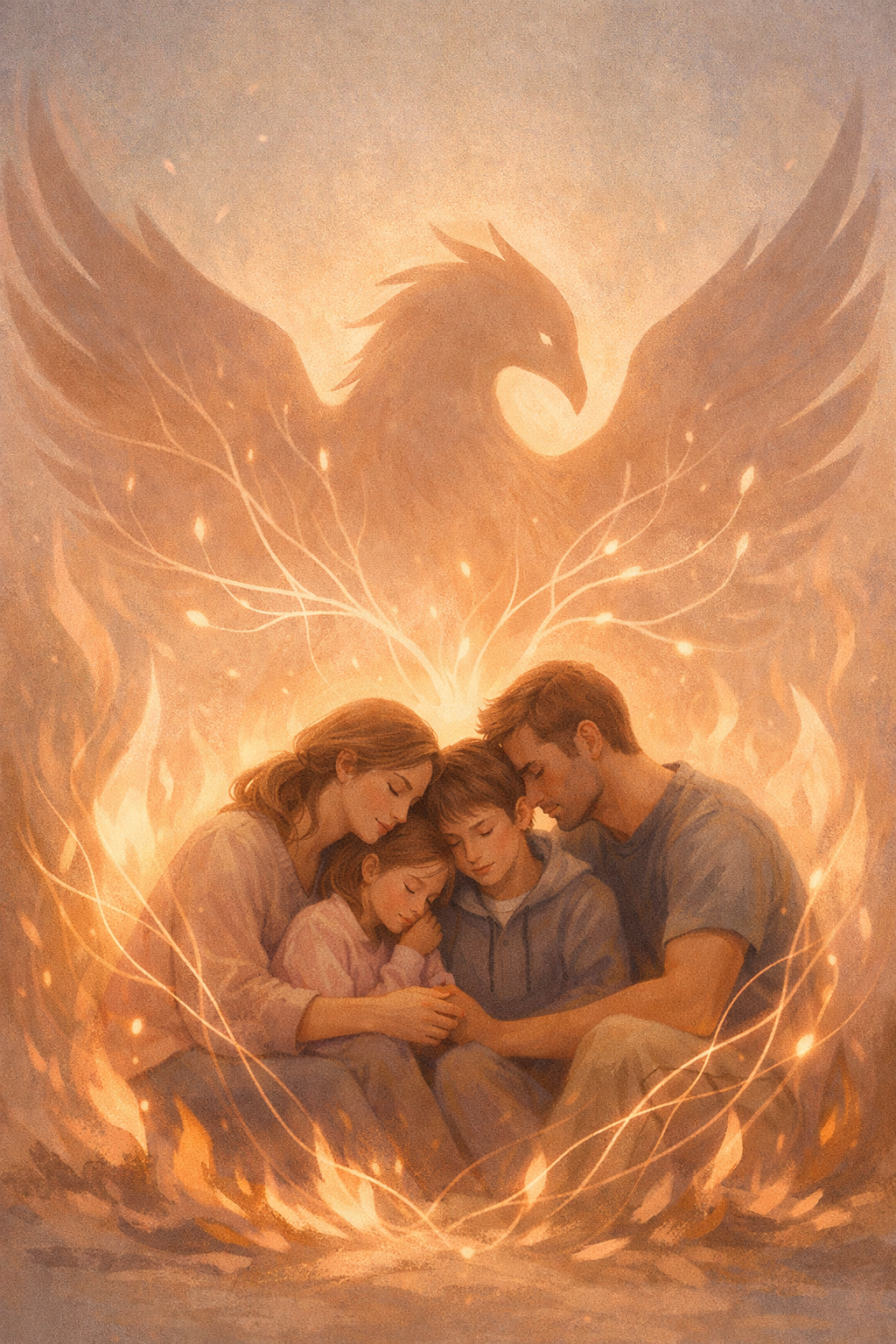
Living Inside the Fire of Addiction
(and its impact on the family system and nervous system)
Addiction doesn’t just affect one person; it permeates the entire household. It spreads through the walls like smoke, altering the air, changing the rules, and redefining “normal.” Even without explicit communication, everyone’s nervous system senses something amiss—a lack of safety, instability, and the potential for sudden change.
Also read : the silent addiction
This concept is often misunderstood until experienced firsthand. The fire isn’t solely the substance; it’s the uncertainty, the waiting, and the way the body learns to remain perpetually on edge.
When addiction enters a family, people don’t simply “deal with it.” Instead, they adapt, organize, and become functions. One person becomes the Fixer,
another the Peacekeeper,
a third the Tracker (monitoring phone calls, lies, money, and moods),
a fourth the Strong One,
and a fifth the Invisible One.
Over time, these roles evolve from strategies to identities. You’re no longer a person; you’re a designated position on a battlefield.
This is evident in family communication: “Don’t upset them,” “Don’t bring it up,” “Just keep things calm,” “We’re fine,” “We’ll handle it.”
However, these statements often mask a deeper truth: we’re attempting to manage chaos through our bodies.
The nervous system suffers the consequences. The body bears the burden. You begin living in constant micro-alarms. A text message arrives, and your heart leaps. A car pulls into the driveway, and your stomach tightens. A tone changes, and your brain scans for danger. Hypervigilance becomes your baseline, not because you’re “anxious,” but because you’ve learned, through repetition, that calm can be interrupted at any moment.
Living inside the fire has a profound impact: sleep becomes light and fragmented, filled with watchful alertness, and your jaw and shoulders remain locked in a state of tension.
- Your thoughts constantly loop, trying to predict the next emotional upheaval.
- Emotions are compressed, leaving little room for genuine expression.
- Your body becomes accustomed to bracing itself as a lifestyle.
The cruel irony is that people will later look at you and say you’re “so strong.”
They don’t realize that “strong” was often just the only option available. They don’t see the cost of being the strong one who can’t break down because the system needs a pillar.
The Love Gets Warped by Survival
This is where things get complicated. You love the person, but you’re also terrified of the pattern.
So, love becomes a complex mix of managing, covering, negotiating, rescuing, raging, pleading, shutting down, and pretending.
This isn’t because you’re broken; it’s because you’re trying to keep something alive with the tools you had.
Many families don’t just suffer from addiction; they’re also trained by it.
They’re trained to walk on eggshells, ignore their instincts, and accept less than honesty because honesty feels destabilizing.
This training doesn’t end when the substance stops; it can linger for years.
Recovery Isn’t Just Sobriety
Sobriety, treatment, and support are important, but family recovery is different.
Family recovery involves:
- Learning to speak without fear
- Learning to set boundaries without guilt
- Understanding that “no” isn’t abandonment
- Learning to tell the truth without making a spectacle of it
- Learning to stop organizing your entire body around someone else’s emotional storms
Family recovery is when the nervous system finally hears:
It’s not your job to hold the whole world together.
It’s when the Strong One becomes… a person again.
Not a role, a function, or a crisis manager; a person.
What Phoenix Field Is Here For
Phoenix Field isn’t here to turn addiction into content. It’s a place where the truth can rest and be unpacked.
A place to say:
- “This changed me.”
- “This shaped my nervous system.”
- “This cost us things.”
• “I’m still learning how to come back to myself.”
And if you’re reading this with that familiar tightness in your chest—the oh yeah, I know this fire feeling—
You’re not alone.
You don’t have to make your story sound good.
You just have to make it true.
If your story is still unfinished, you’re still welcome here.
