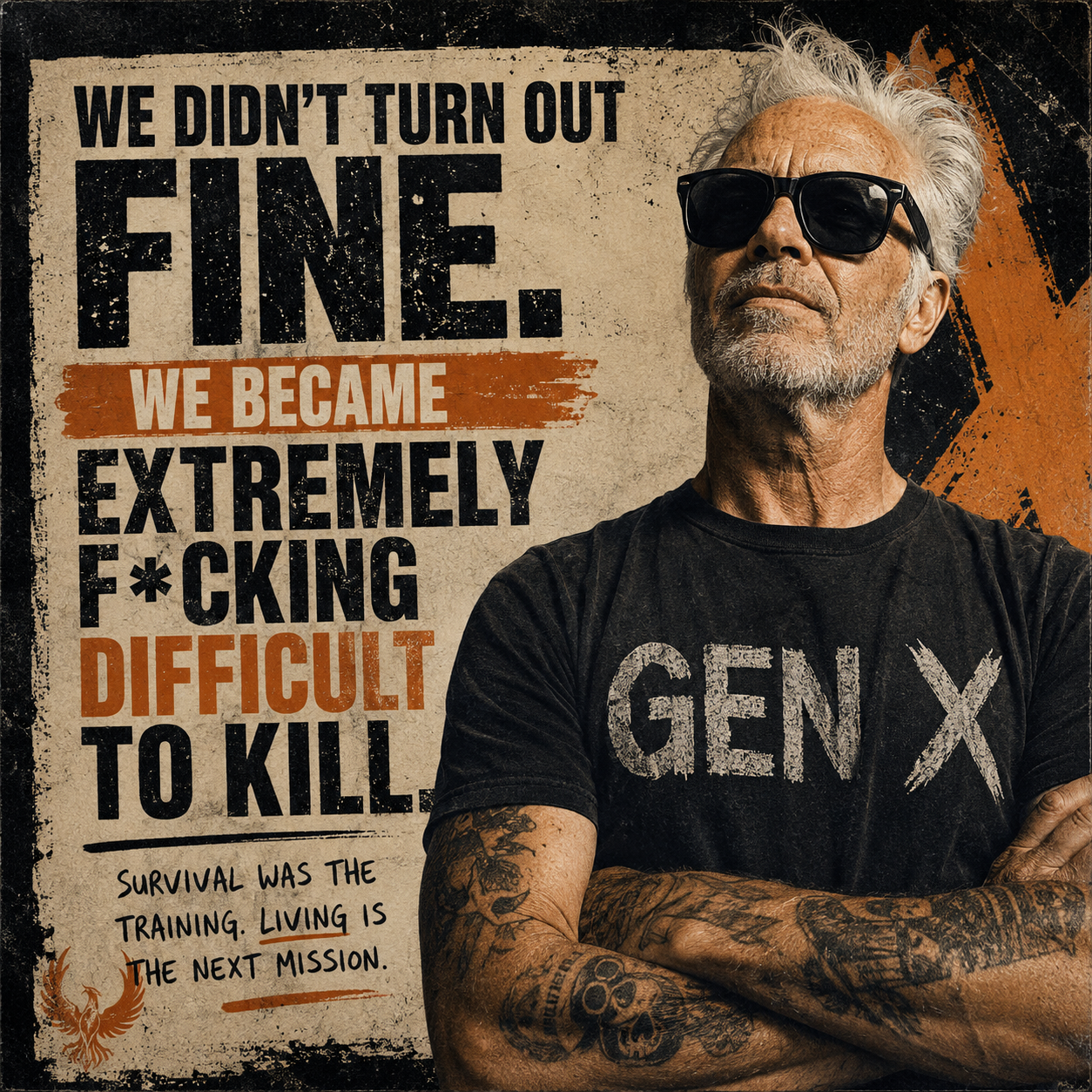
GenX became Extremely Fucking Difficult to Kill
There’s a story Gen X likes to tell about itself. We’re resilient.
Knock us down, we get back up.
Throw some shit at us, we figure it out.
Leave us alone, we’ll manage.
No instructions? Whatever. We’ll take it apart and see how it works.
No one coming to help?
Fine. We’ll do it ourselves.
And there’s truth in that.
Gen X developed a remarkable capacity for survival.
But I’m starting to wonder if we’ve confused two very different things.
Maybe nothing knocks us down.
Or maybe we get knocked down all the fucking time and became exceptionally good at getting back up.
Those aren’t the same thing.
We Get Knocked Down
There’s probably no more Gen X response to adversity than:
I get knocked down, but I get up again.
That could practically be our generational anthem. But getting back up repeatedly has a cost.
Eventually resilience can start sounding less like:
“I know I can handle difficult things.”
and more like:
“What the fuck else am I supposed to do?”
That’s where the story gets interesting. Sometimes some of what we call resilience may not simply be resilience.
Some of it may be an inability to stop surviving.
Survival Is Not the Same as Resilience
Resilience is the ability to experience difficulty, adapt and recover.
Survival mode has different instructions.
Keep moving.
Handle it.
Don’t fall apart.
Don’t need too much.
Don’t wait for somebody.
Figure it out.
For a lot of Gen X kids, those weren’t motivational slogans. They were simply how life worked. Nobody needed to explicitly tell you:
No one is coming.
You learned it. So you adapted.
And a kid who learns that nobody is coming doesn’t necessarily collapse.
Sometimes that kid becomes incredibly capable.
They solve problems.
They become independent.
They tolerate discomfort.
They improvise.
They don’t panic easily.
They get shit done.
Eventually everyone looks at the adult that kid becomes and says:
“You’re so strong.”
Yeah Maybe they are.
But there’s another question worth asking.
Why did they have to become that strong?
The Latchkey Superpower
I don’t want to rewrite the entire Gen X childhood as some giant trauma documentary. Some of it was fucking awesome. There was genuine freedom in being sent outside and disappearing for hours. We explored. We took risks.
We got ourselves into trouble and figured out how to get ourselves back out.
There was confidence built by solving our own problems.
There was something valuable about not having every obstacle removed before we encountered it.
We learned agency.
We learned Competence.
We learned Resourcefulness.
We learned that falling down wasn’t necessarily an emergency.
Those are real strengths.
But nostalgia has a way of cleaning up the edges.
Because often times there’s a difference between:
“I know I can handle this.”
and
“I have to handle this because nobody else will.”
From the outside, those two people can look exactly the same. Inside, they’re living completely different experiences.
One is confidence. The other is survival.
And plenty of us probably carry some mixture of both.
Hello, I’m a Childhood Adaptation
Here’s where things get really fucking interesting. Childhood adaptations have a sneaky habit of becoming adult identities.
The kid who had to be independent becomes:
“I’m just independent.”
The kid who couldn’t rely on anybody becomes:
“I don’t need anyone.”
The kid whose emotions weren’t welcome becomes:
“I’m just not an emotional person.”
The kid who survived chaos by constantly watching the room becomes:
“I’m really good at reading people.”
The kid who had to keep functioning becomes:
“I’m strong.”
And none of those things are necessarily false. That’s the tricky part.
The adaptation eventually becomes an actual ability.
Hypervigilance can make you incredibly perceptive.
Having to figure shit out can make you resourceful.
Emotional containment can make you extraordinarily effective during a crisis.
Self-reliance can build genuine competence.
Survival can create strength. The adaptation worked. Maybe it worked brilliantly. The question isn’t whether it worked.
The question is:
Can you turn the fucking thing off?
The Strong One Has a Problem
Being the person who always gets back up sounds admirable.
Until you realize you don’t know how to stay down. Something hurts. Get up.
Relationship falls apart.
Get up. Someone dies. Get up.
Financial disaster. Get up.
Family crisis. Get up.
Body starts screaming. Get up!!
Everyone around you gradually learns something.
They’ll be fine. Because you always are.
You’re the capable one. The reliable one.
The person people call when something goes sideways.
And there’s a strange consequence to becoming exceptionally good at carrying weight. Eventually nobody notices you’re carrying it. Sometimes even you don’t notice. It’s just what you do.
It’s Tuesday. Of course it’s Tuesday , Tuesday is the GenX middle child of the week.
When Strength Becomes Identity
Here’s where resilience can become a trap. If your identity gets built around capability, then needing help isn’t merely inconvenient. It can feel threatening.
If your value has quietly become tangled with usefulness, independence and strength, suddenly being unable to perform those roles raises a much bigger question.
Who am I if I’m not the strong one?
Life eventually asks that question of most of us. It seems like sooner or later something arrives that cannot simply be pushed through.
You can’t outwork everything. You can’t outthink everything. You can’t grit your teeth hard enough to defeat every loss.
Sometimes the body says no. Sometimes grief says no. Sometimes exhaustion says no. Sometimes life simply puts you on the fucking ground.
And then the old instruction appears.
Get up.
But maybe getting up isn’t always the answer.
Maybe Stay Down for a Minute
That’s almost heresy for people raised on self-reliance. But maybe we don’t have to immediately turn every wound into a comeback story. Maybe something knocked you down because it hurt.
Maybe you’re exhausted because you’ve been carrying too much for too long.
Maybe needing someone doesn’t mean you’ve become weak. Maybe asking for help doesn’t erase everything you’ve survived. Maybe somebody else can carry something for a while.
Maybe somebody can just sit beside you.
Maybe you can say:
“I can’t do this alone.”
And discover that the world doesn’t end.
For some of us, that might require more courage than getting back up ever did.
Yeah sure getting back up is familiar.
Receiving help isn’t.
The Cost of Being Hard to Kill
I don’t want to throw away Gen X resilience. Fuck no.
I love that part of us. We’re resourceful.
We’re funny in catastrophes. We’re suspicious of bullshit.
We’re good at improvising.
We can make something useful out of three pieces of plywood, duct tape and whatever the hell happens to be lying around.
And occasionally we’re powered entirely by caffeine, sarcasm and spite.
There’s something admirable about:
“Whatever. I’ll figure it out.”
That attitude has gotten a lot of us through some serious shit. But I don’t think the goal of the second half of life should be proving how much more we can survive.
We’ve established that. The evidence is pretty fucking convincing.
Maybe just maybe now the work is learning the difference between resilience and survival mode.
Between: I can do this myself.
and I have to do this myself.
Between: I know I’ll get back up.
and I’m not allowed to stay down.
Between strength we choose and strength we were never given a choice about.
We Became Extremely Fucking Difficult to Kill
Maybe Gen X doesn’t possess some magical ability to avoid getting knocked down. We got knocked down plenty.
Some of us got knocked down over and over again. We just kept getting back up.
Eventually that became the story we told about ourselves. We’re tough We’re independent. We’re resilient. We’re fine.
Nothing can take us out.
Yeah there’s truth in all of it.
But there’s another truth underneath it.
We became incredibly practiced at surviving.
That deserves respect. Those adaptations got us here.
They kept us moving when moving was necessary. They protected us when protection was needed.
But survival isn’t supposed to become a permanent occupation.
There comes a point when survival has done its job.
You made it.
You’re here.
You don’t have to keep proving how difficult you are to kill.
Maybe the next question isn’t:
How much more can I survive?
Maybe it’s: What would my life look like if I finally stopped expecting something to come along that I have to survive?
