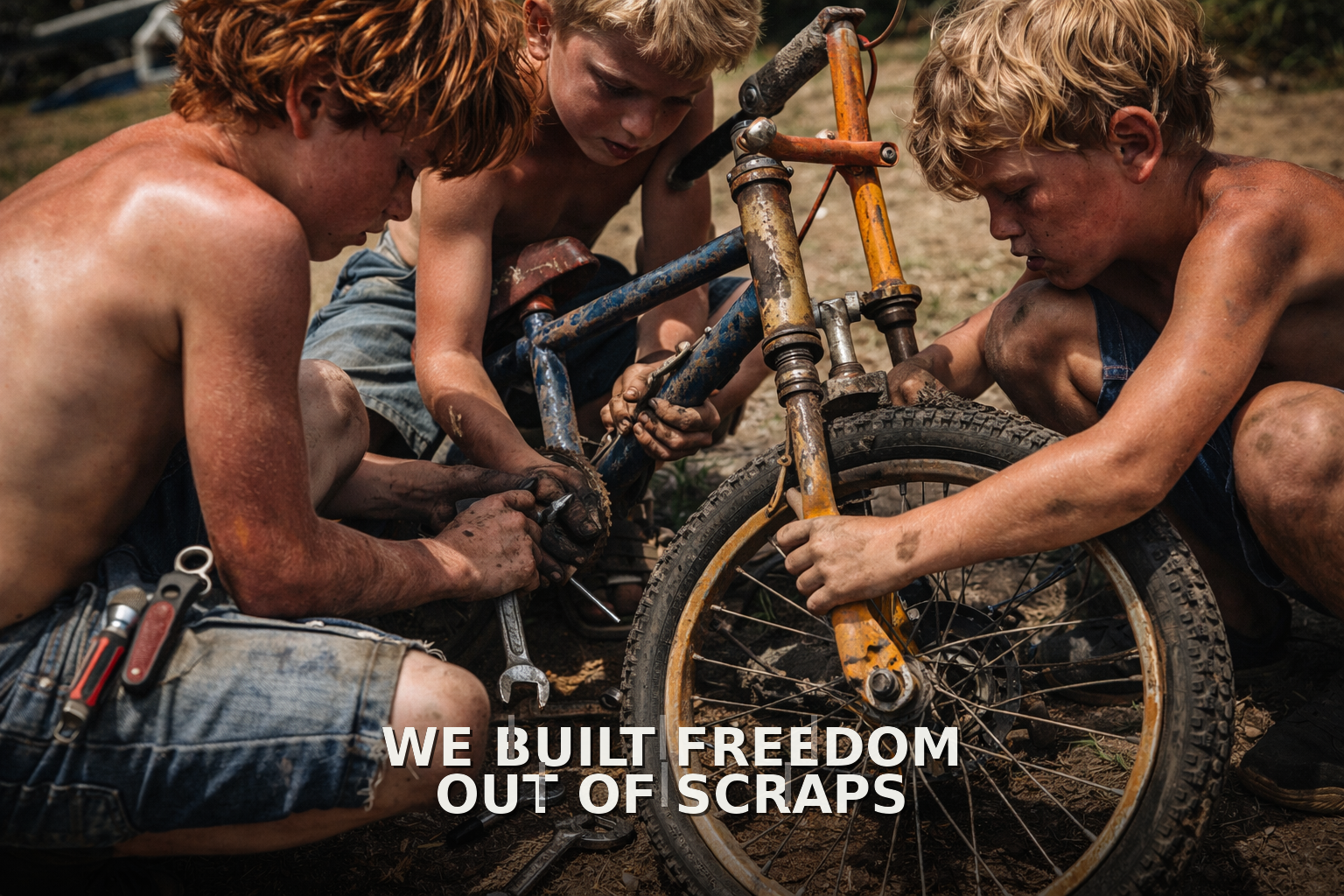
We Built Freedom Out of Scraps
Before freedom had language, it had wheels.
For a lot of Gen X kids, a bike was not just a bike.
It was range.
Escape.
Agency.
A way out of the house.
A way into the day.
A way to disappear for hours and come back when the streetlights came on.
And if you did not have one, you found one.
Or parts of one.
Garbage day was inventory.
Bent frames.
One good tire.
A seat off one bike.
Handlebars off another.
A chain that might hold.
Half-dead BMX skeletons at the curb like somebody else’s broken freedom waiting to be claimed.
So we pillaged the garbage and Frankenstein’d a bike together.
That was the move.
No money.
No shiny new setup.
No adult standing there saying here, let me help you build this.
Just kids in the sun with scraped knuckles, bad tools, trial and error, and a nervous system already learning the rule:
if you want out, build it yourself.
That’s what the bike meant.
Not exercise.
Not a hobby.
Not some curated childhood memory with nostalgic music behind it.
Freedom.
A bike meant you could go.
Go to the store.
Go to your friend’s place.
Go to the woods.
Go nowhere specific and still not be stuck where you were.
That matters more than people think.
Because a lot of Gen X kids were not growing up inside much softness, structure, or emotional support.
There was freedom, sure.
But there was also neglect with better branding.
A lot of exposure.
A lot of self-management.
A lot of figuring it out alone.
So we built mobility.
Built range.
Built a way out.
That’s the deeper thing in it.
We were not just fixing bikes.
We were assembling agency out of scraps.
And that carries forward.
Because a lot of Gen X adults still do this exact thing in other forms.
Build the solution out of leftovers.
Make something usable out of what is broken.
Do not wait to be rescued.
Do not expect much help.
Patch it together.
Keep moving.
That gets praised as resourcefulness.
And some of it is.
But like a lot of Gen X traits, it has a double edge.
Because what looked like ingenuity was often adaptation.
What looked like independence was often early training in not expecting support.
What looked like freedom was sometimes just the absence of anyone really tracking whether you were okay.
That’s why the image still hits.
Sunburnt kids bent over a junk bike in the driveway or alley.
Trying to make one good thing out of discarded parts.
That’s not just nostalgia.
That’s nervous system history.
We built freedom out of scraps because scraps were what we had.
And for a lot of us, that became a life pattern.
Make do.
Patch it together.
Get moving.
Do not complain.
Do not wait around for somebody to hand you what you need.
Useful skill.
Costly identity.
Because eventually the question changes.
Not:
Can I build something out of almost nothing?
A lot of Gen X already proved that.
The better question is:
Can I let myself need more than scraps now?
That’s where the real work is.
Not in losing the grit.
Not in pretending the resourcefulness was worthless.
But in telling the truth about what built it.
A bike was freedom.
But it was also a clue.
A clue that a lot of us learned early:
if you want a way out, you better build it yourself.
That kept us moving.
It just was not the whole story.
Share this with the Gen Xer who learned early how to build a way out and is only now naming what that skill cost.
