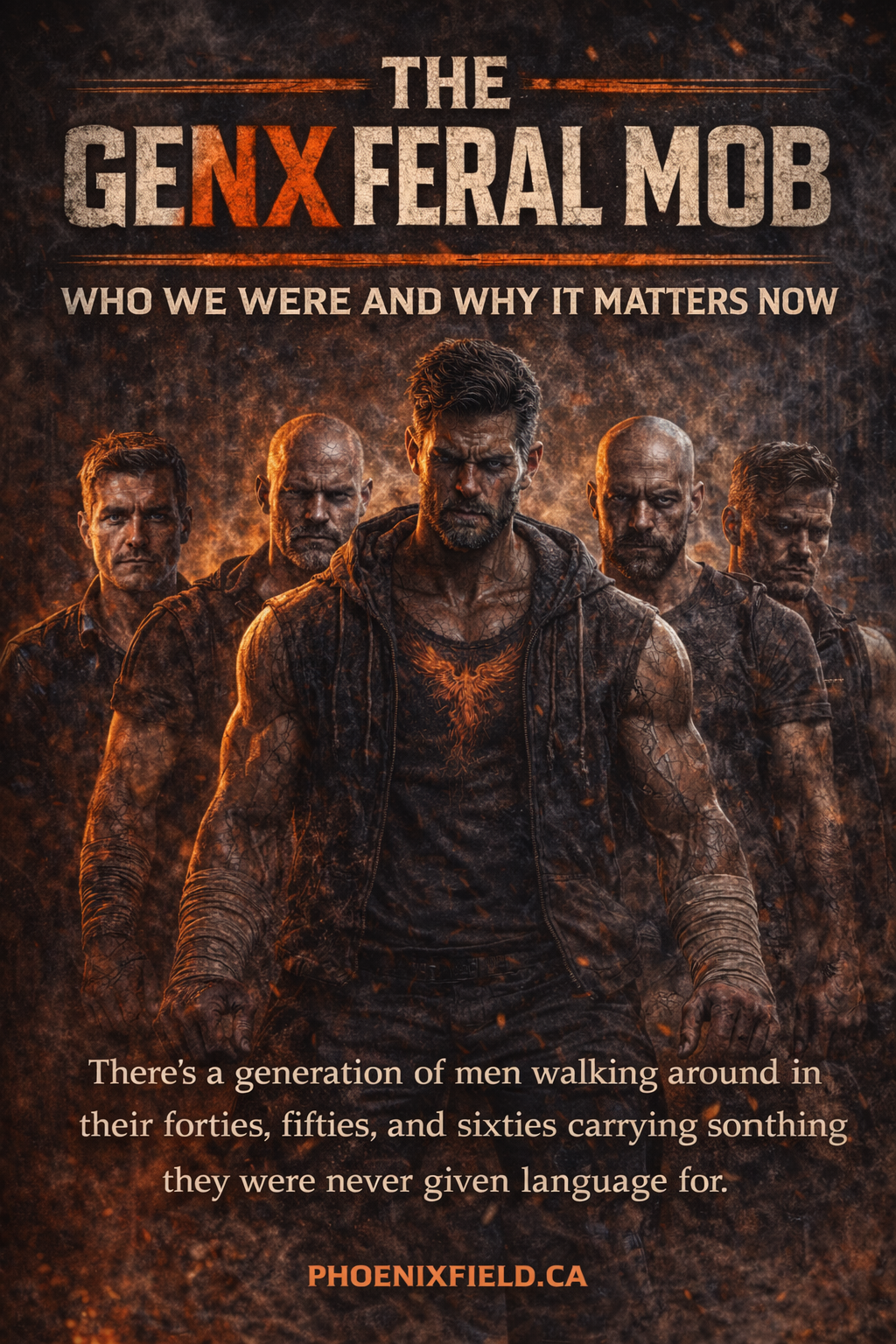
The GenX Feral Mob
Who We Were and Why It Matters Now
There’s a generation of men walking around in their forties, fifties, and sixties carrying something they were never given language for.
They grew up largely unsupervised. Raised by Boomers who were themselves raised by the Silent Generation people who survived wars and depressions and didn’t have the luxury of processing any of it. So they didn’t. And they passed that unprocessed load straight down.
GenX got latchkey keys and told to figure it out.
So we did.
We figured out how to read rooms before we could read books.
How to manage adults who should have been managing us.
How to perform okay-ness in classrooms and at dinner tables while carrying things no kid should have been carrying alone.
We became capable before we became people.
That’s the GenX Feral Mob.
Not feral as an insult. Feral as an accurate description of what happens when children are left to self-organize without adequate structure, safety, or emotional mirroring.
We ran in packs. We solved problems with the tools we had. We developed a specific kind of intelligence street-level, adaptive, high-bandwidth, built for chaos.
And we built armor that still fits so well most of us don’t know we’re wearing it.
What This Series Is
The GenX Feral Mob is a parts work series.
Not therapy-speak parts. Real parts. The internal roles that got assembled in childhood to keep the system functioning when the adults in the room couldn’t or wouldn’t.
Each post maps one part. Where it came from. What it cost. What it looks like when it’s still running forty years later in a grown man’s life.
The parts we’ll be mapping:
The Strong One — the load bearer. The one who holds it together so nobody else has to.
The Analyst — the one who understands everything and feels nothing.
The Radar Kid — the room reader. Half-second ahead of every shift in atmosphere.
The Protector — the one who got between the chaos and everyone else.
The Stabilizer — the one who regulated the adults.
The Good Son — the performer. Compliance as survival strategy.
The Grief Carrier — the one holding the sorrow nobody else claimed.
These aren’t archetypes pulled from a textbook.
They’re the boys we were. Running the only code available to us. Doing the best possible job with what we had.
Why It Matters Now
Because a lot of those parts are still running.
Not because we’re broken. Because nobody ever told them the job was done. Nobody ever said the chaos is over, you can stand down, you don’t have to hold this anymore.
So they keep holding.
And the man in his fifties wonders why he can’t rest. Why he’s always scanning. Why intimacy feels dangerous. Why he can’t receive care without discomfort. Why he’s the strong one in every room he walks into and exhausted by all of it.
That’s not personality.
That’s an un-updated operating system running on hardware that’s been through a lot.
This series is for the men who recognize themselves in that description.
And for the people who love them and want to understand what they’re actually dealing with.
The Work
Naming the part is the first move.
Not to eliminate it. These parts kept us alive. They deserve respect not shame.
But a part that was built for a ten year old navigating chaos doesn’t need to be running the show for a fifty year old man trying to build something real.
The work is updating the code.
Giving the part a new job description.
Or finally telling it you can rest now. I’ve got it from here.
That’s what this series is for.
→ Read Part 1: The Strong One
