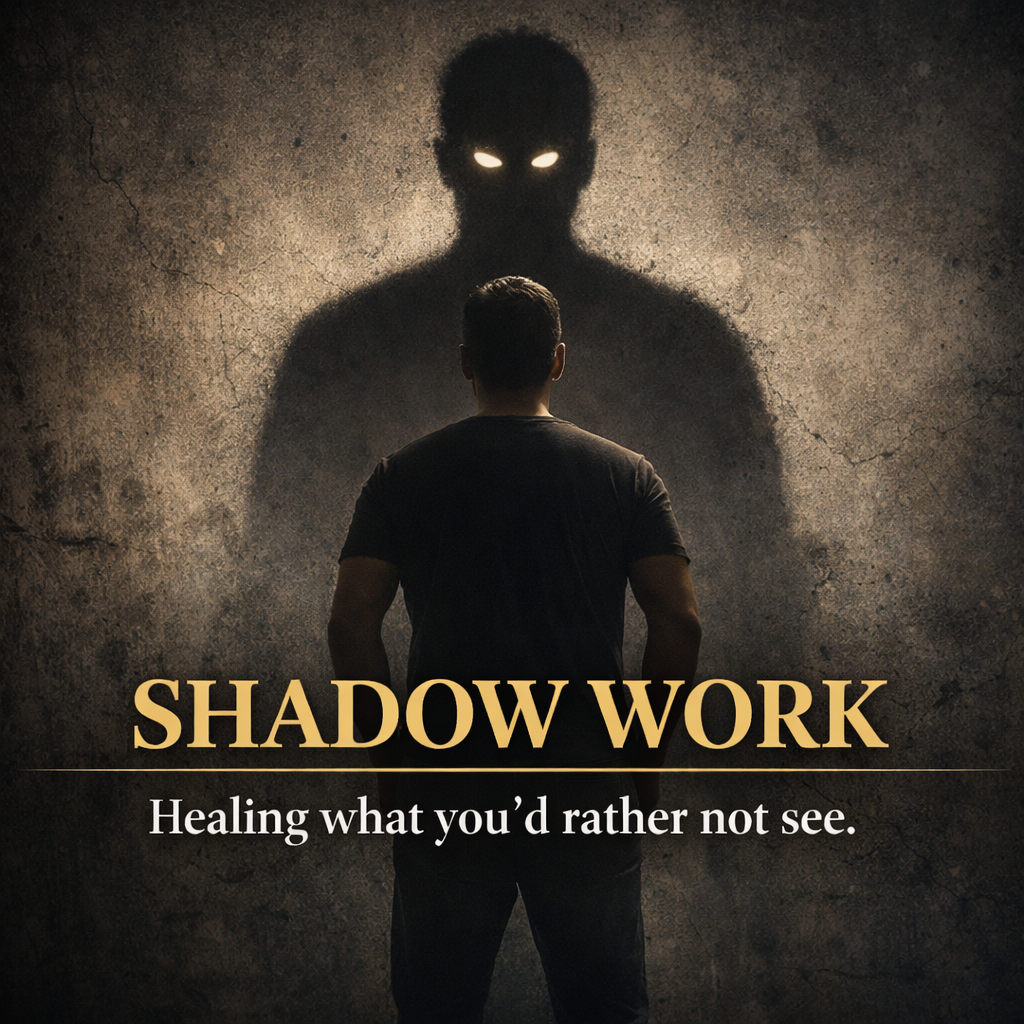
A lot of people talk about shadow work like it is a vibe.
Dark quotes.
Raw captions.
“I’m doing the work.”
A curated relationship with pain.
A public relationship with complexity.
That is not what I mean by shadow work.
To me, shadow work starts where performance ends.
Not when you can talk about your wounds.
Not when you can name your trauma.
Not when you can post about healing in a way that makes people nod along and call you brave.
It starts when you become honest about what survival built in you.
Not just what happened to you.
What you became because of it.
That’s the part people skip.
They will talk all day about what hurt them.
Far fewer want to look at the structure they built around that hurt.
The image management.
The defensiveness.
The self-protection that turned into control.
The wounded identity that became a place to live.
The role that got rewarded so many times it started to feel like a personality.
That’s shadow territory.
Not because it makes you bad.
Because it makes you harder to see clearly if you do not tell the truth about it.
I think that’s why so many people flirt with shadow work but stop short of what it actually asks.
Because real shadow work costs you something.
It costs you the version of yourself that lets you avoid change.
The version that stays innocent by blaming everyone else.
The version that stays safe by staying vague.
The version that stays admired by looking like the one who is always trying.
The version that stays justified by making sure the focus never turns inward for too long.
That version does not go quietly.
It will ghost.
Deflect.
Blame.
Project.
Rewrite the story.
Not because it is evil.
Because identity protects itself.
That’s one of the hardest truths in this work.
People will often protect self-image before they protect truth.
They will burn a relationship down before they take accountability for the part they played in it.
They will praise boundaries until the boundary applies to them.
They will praise accountability until it points inward.
They will praise healing as long as healing stays inspirational and does not cost them access, comfort, or control.
That is not depth.
That is self-preservation dressed up in healing language.
And if I’m honest, I have had to see versions of that in myself too.
Not in the loud obvious ways.
More in the quieter ones.
The part that would rather stay useful than visible.
The part that would rather carry than need.
The part that can understand everything and still stay one step removed from what is actually being asked.
The part that can live inside insight while still avoiding deeper contact.
That’s shadow too.
Not just rage.
Not just projection.
Not just what hurts other people.
The ways I disappear.
The ways I perform okay-ness.
The ways I hide inside roles that once kept me safe.
That’s what makes shadow work real for me.
It is not a hunt for darkness.
It is the slow dismantling of what became false in order to survive.
That can look like losing innocence about yourself.
Losing the right to keep telling the same old story.
Losing the identity that got you sympathy, belonging, praise, or protection.
Losing the image of being the good one, the strong one, the misunderstood one, the one who is always trying.
A lot of people want healing.
Very few want identity loss.
But real shadow work brings it.
Because once you really see the pattern, you cannot unsee it.
Not in relationships.
Not in family systems.
Not in the stories you tell.
Not in the way you manage closeness, conflict, guilt, power, or truth.
Your reality glitches.
That’s the price of becoming more honest.
Not more damaged.
Not more dark.
More honest.
And that honesty cuts both ways.
It does not only tell you who hurt you.
It tells you what you built around the hurt.
What you defend.
What you keep outsourcing.
What you still call “just how I am” because changing it would cost too much.
That’s why discernment matters.
Real discernment is not demanding that everyone else soften, qualify, and pre-explain everything so you never have to get uncomfortable.
Discernment is an inside job.
Does this apply to me?
Does it not?
Why does this hit so hard?
What am I defending?
What am I trying to keep intact?
Am I reacting to truth, or to the threat of losing an identity that has protected me for a long time?
That is shadow work.
Not self-hatred.
Not public confession.
Not becoming obsessed with your own darkness.
Truth with consequence.
And consequence is the part people do not like.
Because once the work is real, something has to change.
A relationship.
A role.
A pattern.
A way of speaking.
A way of avoiding.
A way of staying false while calling it survival.
That is why people talk about healing more than they let healing change them.
Because change asks for payment.
And the payment is usually a version of yourself you have been living inside for a very long time.
For me, that is the heart of the whole thing.
The shadow is not just what hurt you.
It is what you became to survive it.
And real work begins the moment you stop protecting that version of yourself at all costs.
Share this with someone who knows healing is not just about naming what hurt you, but telling the truth about what you became in order to survive it.
