Grief is not a problem to solve.
It’s a wave to survive.
Some nights it arrives gently, a quiet ache, a soft remembering.
Other nights it hits like your nervous system just opened a door couldn’t enter before.
A smell.
A song.
A photo.
A sentence you didn’t expect to hear in your own mind. “I could have done more”
And suddenly you’re there again. in that moment. It’s as real as the hear and now.
Not because you’re broken.
Not because you “can’t let go.”
Because your body is faithful. Because love leaves an imprint.
Because the nervous system stores what the heart couldn’t afford to feel all at once.
Grief doesn’t move in a straight line.
It moves in flushes.
In images.
In body memory.
And if you’ve lived through trauma, loss, ICU rooms, hospital alarms, late-night calls, the “please not this” moments those pictures don’t just live in your mind.
They live in your body.
Sometimes the most healing thing you can do is stop trying to “process” it and simply create enough safety for it to move.
That’s what presence is.
Not advice.
Not fixing.
Not forcing meaning.
Presence is the quiet statement:
“I’m here. You don’t have to do this alone.”
Last night, grief came through the room like the weather.
A wave.
A sob.
A longing: I just want to hold him.
And the images came…. the ones that never belonged to a mother’s eyes.
The ones that get stored because there was no other place to put them.
All I could do was stay.
Breathing.
Not leaving.
Not explaining.
Letting the wave, the motion move.
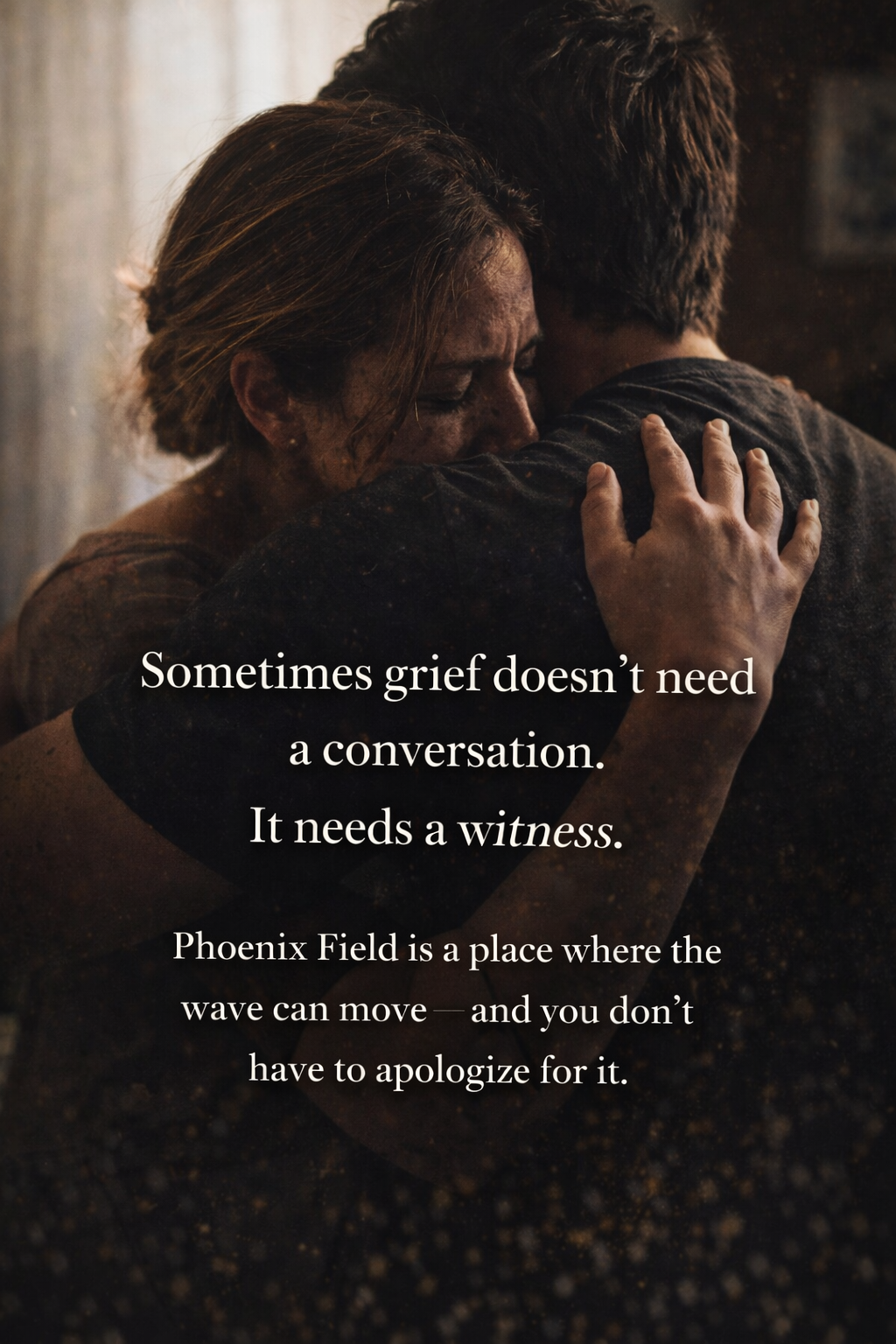
Because sometimes grief doesn’t need a conversation.
It needs a witness.
And here’s the part we don’t say out loud enough:
When you hold someone through grief, parts of you will grieve too.
Not always for the same thing.
Sometimes for the way you had to become “the strong one.”
Sometimes for years you carried what no one helped you carry.
Sometimes because your body recognizes the moment as sacred and heartbreaking and familiar.
So if you’re the one beside the grieving person…
you are allowed to need tenderness too.
You can be the anchor and the one who needs anchoring.
That’s not a weakness.
That’s being human.
If you’re grieving today, I want you to hear this clearly:
You are not behind.
You are not failing.
You are not “living in the past.”
You are living in love’s aftermath.
And if the grief is coming now, it may be because your system is finally saying:
“It’s safe enough to feel this.”
Not safe as in “nothing hurts.”
Safe as in “I’m not alone in it.”
So here’s a simple Phoenix Field practice not a ritual, not a performance just a return:
One hand on your chest.
One slow exhale.
Whisper (or think): “I’m here.”
Then: “I’ve got you.”
Even if no one else can say it right now.
Let it be true in your body for one breath.
Grief doesn’t mean you’re losing ground.
Sometimes grief is what happens when your system finally stops running.
And in that stopping, the love shows up.
Not as a story.
As a wave.
Let it move.
Phoenix Field is a place where the wave can move and you don’t have to apologize for it.
