Most people think grief is about losing someone. I don’t think that’s what grief is.
Loss may be the event. Grief is what happens after. It’s the place where life quietly asks a question you’ve probably spent years avoiding:
Now that everything has changed… who are you?
When Aidan died, I thought my grief was about him. And of course it was. I missed him. I still do.
But as the months unfolded, something unexpected happened.
The grief stopped pointing only toward him. It started pointing back toward me.
Toward the man I had become. Toward the life I’d built. Toward the ways I’d survived long before this loss ever arrived.
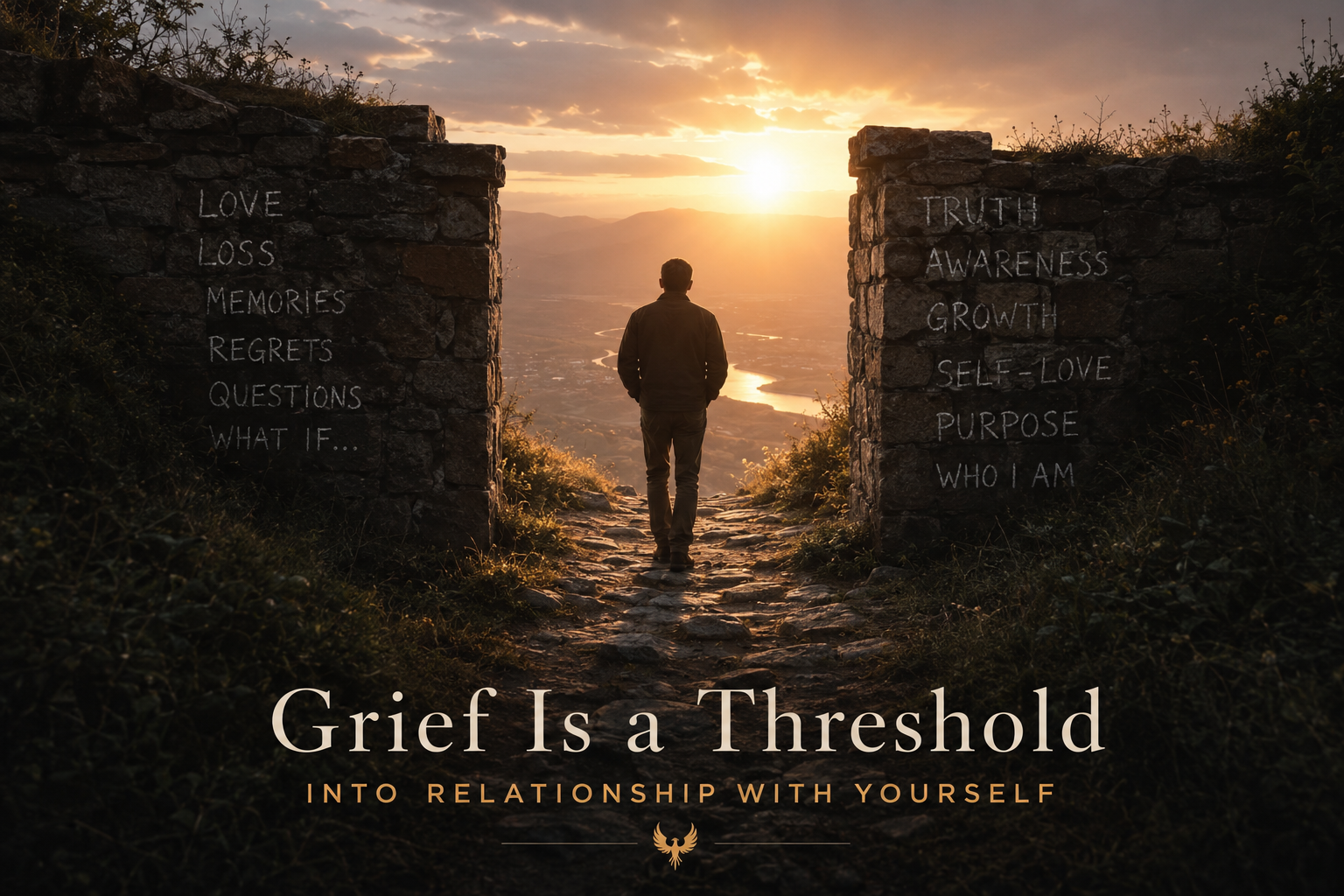
Grief became less like a wound to fix and more like a doorway I couldn’t walk around. It was asking me to enter.
Not to escape. Not to transcend. Not to bypass. To enter.
Most of us imagine grief as something to get through. A season. A process. Five stages. A finish line. But grief doesn’t work like that. It doesn’t move in straight lines. It moves in circles. It revisits. It surprises. It waits patiently until we’re ready to feel what we couldn’t feel before.
That’s why grief often reveals things that have nothing to do with the person we’ve lost. It exposes the hidden architecture of our lives. The roles we’ve been carrying.
The stories we’ve been believing.
The ways we’ve learned to protect ourselves. The relationships we’ve neglected. The parts of ourselves we’ve abandoned just to keep functioning.
Loss doesn’t create those things.
It reveals them. That’s why grief feels so overwhelming. You’re not only mourning a person. You’re meeting yourself.
Sometimes for the very first time.That’s uncomfortable.
Because grief has a way of stripping away performance. You can only pretend to be okay for so long before your body starts telling the truth.
Mine certainly did.
For most of my life I knew how to perform strength.
Show up. Handle it. Solve the problem.
Keep moving. People called me resilient.
Capable. Reliable. Those qualities are real.
But grief showed me something I couldn’t see before.
Some of that strength wasn’t freedom.
It was adaptation. It was survival.
It was a nervous system that learned long ago that stopping wasn’t safe.
Grief didn’t make me weak. It made my strategies visible. That’s a very different thing.
I don’t believe grief is trying to punish us. I think it’s trying to reconnect us. Reconnect us with our bodies.
Reconnect us with our humanity. Reconnect us with the parts of ourselves that survival pushed underground.
It’s an invitation. Not an easy one.
Certainly not one any of us would volunteer for. But an invitation all the same. You don’t become wise because you grieve.
Plenty of people stay trapped inside grief for decades.
The threshold only becomes transformative when we’re willing to stay in relationship with what grief is revealing.
To stay curious instead of defending.
To feel instead of performing.
To tell ourselves the truth instead of reaching for another distraction.
That’s where healing begins.
Not because the grief disappears.
But because something inside us becomes more honest. Today my relationship with Aidan is different.
He’s no longer someone I can call or hug.
But my relationship with what loving him awakened in me continues every day.
So does my relationship with myself.
That’s the unexpected gift grief offered.
Not closure. Not answers. Relationship.
If you’ve lost someone, I won’t tell you that everything happens for a reason.
I don’t know that.
What I do know is this: Grief has an extraordinary way of revealing what mattered most.
And if you’re willing to stay with it…
It may also reveal who you’ve been underneath the roles, the responsibilities, the conditioning, and the endless effort to keep going.
Sometimes grief is the place where love changes form. Sometimes it’s the place where life introduces you to yourself.
Not the version built to survive.
The one that has been waiting beneath it all.
